

The challenge of paying workers a living wage is weighing heavily on the minds of many total rewards leaders these days. Some companies have boosted pay to address this growing concern, but wage hikes represent only part of the total rewards equation. Enhancing certain employee benefits designed to alleviate financial — and other — pain points offers another pathway to meet living wage standards.
Take childcare, for instance. In the U.S., working parents are struggling to find and afford acceptable solutions. Even for two-income families, childcare is the highest living wage expenditure — exceeding even housing costs — and gobbles up more than 20% of wages earned by each employee, according to the MIT Living Wage Calculator.
Many of these working parents would welcome help from their employers, according to recent surveys. For example, employer-provided benefits that help pay for childcare was the top wish of 46% of respondents in the most recent Modern Family Index, slightly ahead of both flexible work hours and unlimited remote work. In addition, 57% of parents responding to a recent KinderCare survey said they would take a pay cut to work at a company that provides childcare benefits.
Companies are taking notice of survey results like these — and in some cases enhancing their childcare benefits as a result, according to Matthew Nestler, senior economist at KPMG. In fact, 56% of organizations said they would prioritize childcare benefits in 2024, up from 46% in 2023, a Care.com study found.
The good news for employers is that there are lots of ways to help alleviate parents’ childcare-related stressors — and some of these options are relatively inexpensive and offer significant potential return on investment. The trick will be for organizations to find the options that are most appropriate for their workforces.
Childcare is generally considered affordable as long as it doesn’t exceed 7% of a family’s household income, according to the Department of Health and Human Services. However, families are easily spending between 8% and 19.3% of their income on childcare expenses, depending on the age of the child and the place of care, according to a recent federal analysis of the Women’s Bureau’s National Database of Childcare Prices. (The figures are based on 2018 data and adjusted to 2024 amounts.)
The strain on households has worsened over time: Daycare and preschool costs rose at nearly twice the pace of overall inflation between 1991 and 2024.
It’s not just a blip in the data, either. The strain on households has worsened over time: Daycare and preschool costs rose at nearly twice the pace of overall inflation between 1991 and 2024, according to an analysis by KPMG of publicly available data from the Bureau of Labor Statistics.
Exacerbating the problem is the fact that since pandemic-era benefits and subsidies for childcare providers expired, operating cost increases are now often passed on to parents in the form of higher tuition.
In addition to cost, access can be a serious concern. An ongoing shortage of workers in the childcare sector, which is notorious for paying low wages, means parents struggle to obtain childcare — particularly in certain areas of the country. In these so-called childcare deserts, the KPMG report notes, the number of children might be three times higher than the number of available slots at licensed facilities — or there might not be any facilities at all. So, even if employees can afford childcare, they may still struggle to obtain it.
The upshot of all of this is that “parents are facing high prices, [childcare] workers are facing low wages, and no one’s really benefiting from this,” said Nestler, a co-author of the report.
What’s more, the need for childcare may be increasing as some organizations begin to pull back on remote work, reportedly leaving working parents scrambling to find new, different or additional care arrangements to cover in-office days.
When childcare issues plague workers, employers pay a price. Employees struggling to afford or access childcare may have to call in sick, shift to part-time work or leave the workforce entirely. That results in $13 billion a year in lost productivity for employers, as well as higher turnover, a depleted workforce from which to recruit and extra strain for colleagues who have to pick up the slack.
Women are disproportionately affected by the childcare crisis. “Almost 90% of those missing work or cutting down their work hours, working part time, due to childcare problems are women, and 70% are women between the ages of 25 and 44,” Nestler said, pointing to findings from KPMG’s new Parental Work Disruption Index, which measures how inadequate childcare options affect employees.
Higher childcare prices also have the potential to drive mothers out of the workforce altogether, dragging down the labor force participation rate for women, affecting household income and resulting in less economic output. When childcare prices are reduced by 10%, however, U.S. studies show that it leads to an increase in mothers’ employment of 0.25% to 11% — data that is further expanded in findings cited by the Department of Labor.
Nestler also noted that employees from different income levels will experience the childcare crisis differently.
“Higher-income workers have to pay more; that impacts savings, and that is significant,” he said. “With lower-income workers, the consequences are much more dire. Just one hour of work missed a week can lead to lost wages of between $780 and $1,504 each year,” which can severely strain low-income households, potentially translating to financial instability and even food insecurity. “So, it’s really, really stressful on the lower-income spectrum when it comes to childcare.”
For lower-income individuals, having access to childcare benefits may be just as good as pocketing more cash — an example of how non-compensation rewards can be a viable alternative for companies that face challenges in paying a living wage.
By helping employees with the cost of childcare, employers also help themselves: Offering childcare benefits is known to translate to better recruitment, retention and productivity.
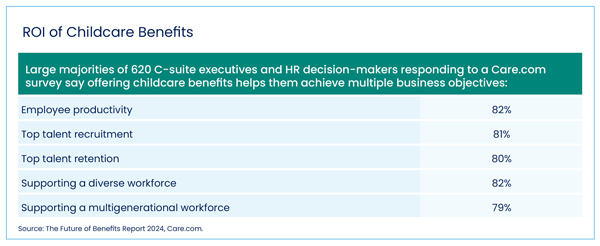
“The benefits have been known for a while,” Nestler said. “It helps companies gain an edge over competitors in attracting and retaining talent.”
Even so, childcare benefits overall are still hard to come by for workers. According to Boston Consulting Group (BCG), just 12% of all U.S. workers have access to such benefits through their employer, and that number drops to 6% for people who work part time or are in the lowest income quartile.
If childcare benefits result in notable gains for organizations, why don’t more companies offer them? Cost is often cited as a reason. However, a study earlier this year by BCG and advocacy group Moms First concluded that childcare benefits may be self-funding or even provide a net a positive return. The five organizations that participated in the study invested in various childcare benefit strategies — including onsite facilities, backup services and stipends — and saw positive returns ranging from 90% to 425%, according to the researchers.
Reshma Saujani, founder and CEO of Moms First, called the report “proof that childcare benefits not only pay for themselves, but also make financial and strategic sense, creating an advantage for businesses that step up and make the investment in their employees.”
Leaders at Patagonia would agree. One of the ways the outdoor clothing and equipment retailer supports working parents is by offering onsite childcare at its three main North American locations. The company introduced the benefit to employees at its Ventura, California, headquarters in 1983 and expanded it to workers at its design center in the same city and at its Reno, Nevada, distribution center in the 2010s. Currently, there are a total of 17 classrooms in use — all with access to outdoor space — and more than 200 children being served.
Patagonia has about as many women as men in leadership positions, which it attributes to the childcare support they receive from the company.
“There’s no waitlist,” Sheryl Shushan, Patagonia’s director of global family services, told Workspan. “All employees who live in a location where we offer onsite childcare are invited to participate.” In addition to charging average market rates for the care, she noted, the company provides subsidies to employees whose household income falls below a certain threshold.
“Offering onsite childcare is expensive,” Shushan noted, “but we believe the benefits far outweigh the costs.”
Among the returns Patagonia has seen from its investment is retention of new moms: “We have nearly 100% of women return from maternity leave,” said Shushan, who explained that the low turnover translates to fewer recruiting, training and relocation expenses. Patagonia also has about as many women as men in leadership positions, which Shushan attributed to the childcare support they receive from the company.
Providing onsite childcare is just one of the ways employers can support working parents — and enjoy the associated business returns. To address the dual issues of affordability and access, other strategies include:
1. Options that help employees manage cost.
2. Options that help employees gain access to childcare.
3. Options that help ease both stressors.
Companies may also be able to take advantage of state programs that incentivize employers to offer childcare assistance.
“There is a lot of work being done at the state level, especially on universal pre-K and paid family and medical leave,” said Matthew Nestler, senior economist at KPMG. “It’s occurring in states across the political spectrum, oftentimes working in concert with businesses, because there is a growing understanding that childcare is a question of business competitiveness.”
Florida, Vermont and Oklahoma have been pioneers in this area, he noted. In Florida, for example, tax credits are available for businesses that open an onsite childcare facility and that otherwise help offset the cost of childcare for their workers.
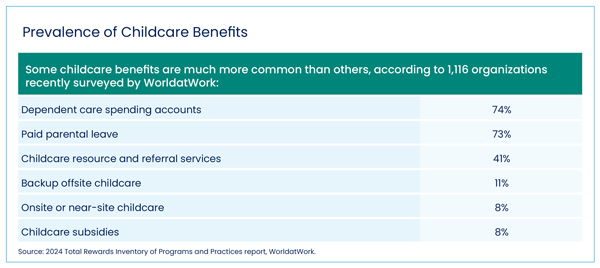
According to WorldatWork’s 2024 Total Rewards Inventory of Programs and Practices, many employers already provide paid parental leave (73%) and dependent care spending accounts (74%). But considerably fewer offer childcare cost and access strategies, such as childcare subsidies (8%) and backup care (11%), which can be meaningful solutions for employee needs and employer goals alike.
Here are examples of how organizations adopted lesser-utilized types of childcare options for their employee populations — and the results they achieved.
One of the companies that participated in the BCG/Moms First study was UPS. The shipping giant was experiencing high turnover of its front-line workforce, according to Danelle McCusker Rees, global head of talent and learning, and it thought issues related to childcare might be the culprit. A study revealed that difficulty finding backup childcare was the main issue. So, UPS launched a three-month emergency onsite care pilot program at one of its warehouse facilities in late 2022 to see what effect it might have.
Almost half (47%) of the workers enrolled in the program were single parents, and nearly 90% were women, Rees said. During the pilot program, she added, over 120 worker absences were avoided, with 77% of the care bookings made within 48 hours of the shift that would have been abandoned due to a childcare conflict. At the same time, employee retention for the shift improved from 69% to 96%.
UPS was so pleased with the results that it has since expanded the pilot program to facilities in seven more states. “Utilization in the expansion sites is similar to the pilot,” Rees said, “and we have a 100% reuse rate across all sites. Every eligible parent who has tried the program in 2024 has rebooked care.”
UPS also offers nonunion employees access to a dependent care flexible spending account and has a program called Resources for Living that is available to all employees. One of the things the Resources for Living program provides is an online tool to help employees search for and evaluate childcare providers in their area.
Etsy is another company that offers subsidized backup childcare, with employees receiving 20 care credits each year, according to a company spokesperson. Also available: 26 weeks of fully paid parental leave for all genders following the birth, adoption or fostering of a new child.
To provide greater flexibility, new parents have the option to trade in up to 14 weeks of their parental leave time for a cash benefit to support their transition back to work.
Dow Chemical Co. unveiled new childcare benefits in June after a voluntary employee survey revealed that cost was the primary challenge faced by workers, followed by access and quality of care, according to Michael Horne, head of global rewards.
Through the company’s Childcare Assistance Program, U.S. employees who qualify can enroll to receive a $1,500 contribution from Dow to their dependent care flexible spending account to use toward childcare expenses. Qualification for the program is based on workers’ annual base pay and/or job grade.
Dow also provides employees with up to $600 annually for use toward emergency childcare if they must show up at a time when they weren’t scheduled to work. “For example, the Emergency Childcare Stipend would support an employee who is required to report to work unexpectedly to support an unplanned event or a plant interruption,” Horne said.
The emergency childcare stipend program is administered by tech platform TOOTRiS, which pays the childcare provider directly. Dow employees can also use TOOTRiS to locate a new childcare provider, enroll for care and automatically process payments.
Fast Retailing Co. Ltd., one of the companies that participated in the BCG/Moms First study, has structured its childcare benefits to focus on the high cost. It provides parents of young children with a monthly stipend of $1,000 that can be used for up to three years for children up to age 6-1/2.
A sizable majority of working parents at the company (86%) told researchers they are more likely to stay at Fast Retailing thanks to the childcare benefits, and 4 out of 5 said their career has been positively impacted.
“Supporting working mothers and parents is not just a matter of policy — it’s an economic imperative,” said Serena Peck, the company’s USA chief administrative officer and general counsel.
The company also offers its employees access to a dependent care flexible spending account, paid parental leave and other family-forming benefits.
The right mix of childcare benefits will depend on each organization’s business model and workforce demographics, according to Nestler.
For example, a workforce made up mostly of front-line employees might prefer onsite childcare, he noted, while one with employees that work in a hybrid or remote capacity might prefer discounts at center-based daycare facilities. Access to backup dependent care service and scheduling flexibility can appeal to a wide swath of workers, he added.
“There’s no one-size-fits-all policy,” Nestler said. “It’s more about understanding your employees’ needs, figuring out what the return on investment is for these different policies depending upon what your workforce looks like, and then instituting a policy and evaluating the outcomes in reference to variables like productivity and turnover.”